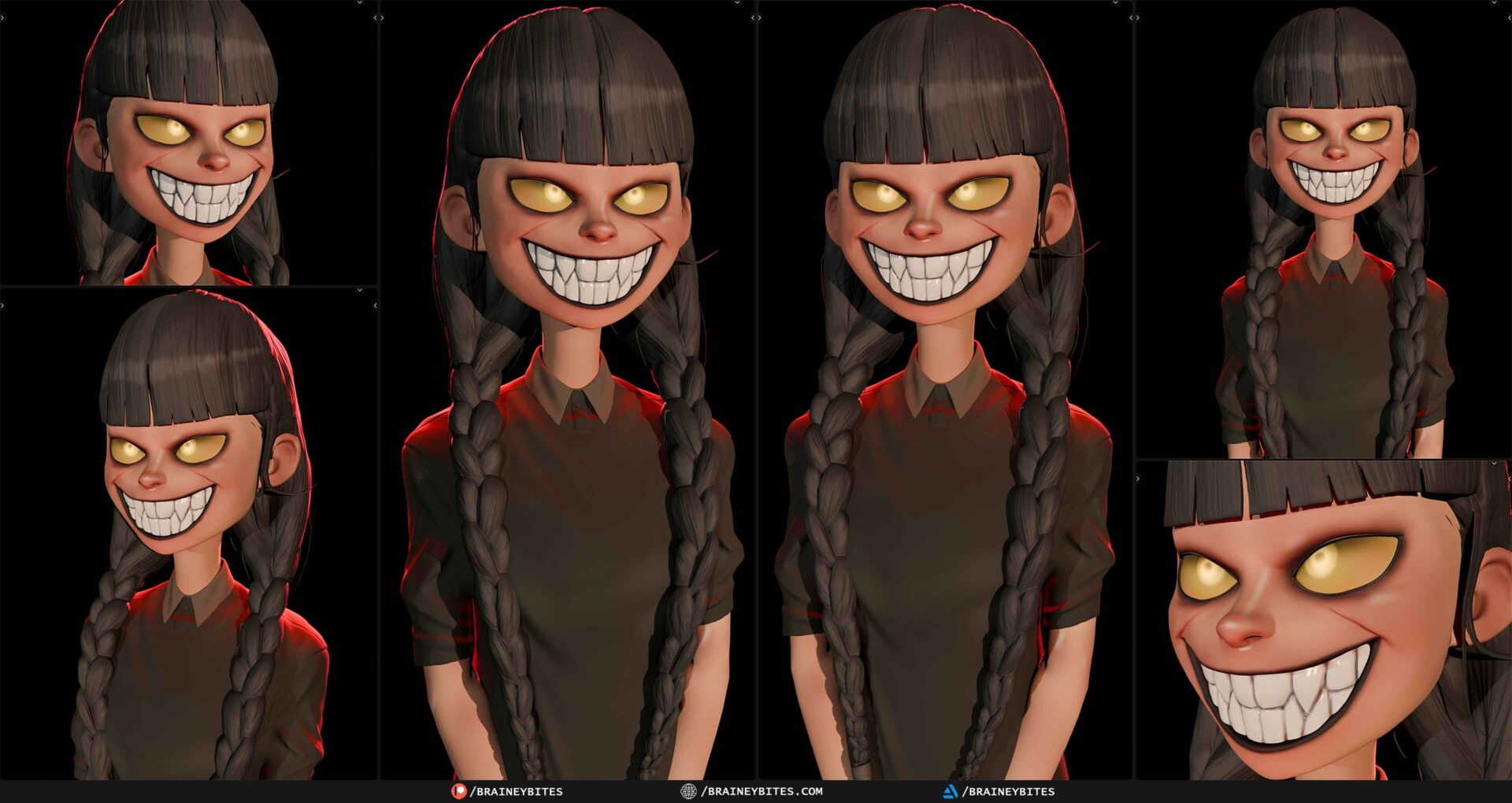
I found the reference while scrolling one evening and couldn’t stop looking at it — a wide, slightly-too-wide grin, and eyes that didn’t match the calm expression underneath them. That mismatch is the whole reason I wanted to build it. Most stylized faces settle for a grin that reads as friendly; this one reads as friendly and then, a beat later, doesn’t. I wanted to see if I could get that same double-take into a 3D sculpt.
Starting from a sphere
Every character I build starts the same way: a bare UV sphere, dynamic topology on, nothing else in the scene. No base mesh, no block-in kit — the proportions are entirely my problem from the first pull. The first real stretch of work was pure blocking: skull mass, jaw line, the rough seat of the eye sockets. Getting that underlying shape right mattered more than anything that came after it — if the skull’s proportions are off here, no amount of later detail work rescues it.

The grin was the hard part
I did not expect the mouth to be the bottleneck, but it was, by a wide margin. A grin this wide has almost no reference for how the cheeks and jaw hinge should deform to support it without the whole face reading as broken. I went back and forth between the mouth and the eyes more times than I want to admit — widen the grin, and the eye sockets suddenly looked wrong; fix the eyes, and the grin lost its edge.

Hair and the parts that aren’t the face
The braids were built as their own geometry and shaped by hand rather than generated — at this scale, hand-placed strands sit against the head more convincingly than a procedural system would, but it’s slow, repetitive work that doesn’t look like much is changing from one pass to the next. The collar of the outfit gave me more trouble than I expected too; getting fabric to sit naturally against a neck this stylized meant it couldn’t just be a straight extrude.
Painting and the final render
Color went on last, and in a specific order: skin tone first, then the eyes, then lips and blush, then hair and clothing. Watching the sculpt go from flat grey clay to a fully colored character in that final stretch is, honestly, still my favorite part of any build.

What I’d do differently
The braids could carry a bit more variation along their length — real braided hair loosens and thickens unevenly, and mine reads slightly too uniform up close. I’d also start the eye-socket shaping earlier relative to the mouth next time, since most of the back-and-forth in the middle of this sculpt came from doing them too sequentially instead of in parallel.

If you want to see the process this post describes rather than just read about it, the full timelapse, the short cut, and the completely raw unedited footage are all linked from the channel.
